News & Insights
April 17, 2026
Case Study: Powering the AI Physicist
March 24, 2026
The Global Contest for AI Sovereignty
NeurIPS 2025 (the 39th annual Neural Information Processing Systems conference) showcased a pivotal shift in AI research trends. While large language models (LLMs) still featured prominently, many researchers turned their focus toward AI agents and world models, as well as next-generation generative models like diffusion transformers for images and video.
These advances signal a shift away from purely scaling up LLMs toward AI systems that can understand and simulate the world around them, a capability requiring tremendous computational power. The conference underscored how access to high-end computing (think GPUs like NVIDIA’s H200 and Blackwell B200) is critical for turning these ambitious ideas into reality.
In this post, we recap the NeurIPS highlights around AI agents and world models and explore why cutting-edge GPUs and the right cloud infrastructure are so essential for these breakthroughs. We also illustrate how BUZZ HPC’s Canadian sovereign neo-cloud, with its high-end GPU clusters and advanced AI services, is empowering researchers and organizations to ride this new wave of innovation.
A key theme at NeurIPS 2025 was a resurgence of interest in world models. We define these as AI systems that learn an internal model of the environment to predict and plan outcomes. In fact, an entire workshop was devoted to Embodied World Models for Decision Making, emphasizing that world models have become a cornerstone of embodied AI and are powering recent advances in decision making and planning for autonomous agents.
By learning a rich representation of the world, whether a physical environment or an abstract task domain, an AI agent can simulate possible futures, reason about consequences, and make better decisions. This shows that the field is drifting toward goal-directed interaction in both physical and simulated worlds.
Even legendary AI figures echoed this shift. At NeurIPS, RL pioneer Richard Sutton argued that the field needs to return to learning agents that build world models and learn continually, and he suggested that recent years’ fixation on massive data and static models might have lost sight of these fundamental ideas. His call to action underlines a community desire to imbue AI agents with more cognitive autonomy. We define that as the ability to explore, remember, and adapt like a human or animal would in its environment. World models are seen as a key ingredient to achieve this, enabling agents to internalize how the world works and then plan or improvise within it.
Some of the Best Paper research at NeurIPS touched on related areas. One best paper by Wang et al. demonstrated that pushing neural network depth to extreme scales (e.g. 1000 layers) can unlock new capabilities in reinforcement learning agents, allowing them to learn to reach goals without any rewards or demonstrations. Larger models plus world modeling might yield breakthroughs in agent behavior if one has the computational resources to train such deep networks.
Another runner-up paper critically examined fine-tuning LLMs with reinforcement learning, finding that current methods did not produce fundamentally new reasoning abilities beyond the base model. Simply bolting RL onto an LLM is not enough. Deeper innovations, perhaps world model based reasoning or new architectures, are needed to give AI agents truly new cognitive skills.
Overall, NeurIPS 2025 showed clearly that AI agents are a hot topic once again. Researchers are equipping agents with world models, memory, and planning ability. Early examples include architectures that integrate symbolic reasoning or dual minds for long-term imagination, and approaches like EDELINE, a unified world model that cleverly combines state-space models with diffusion generative models.
By integrating diffusion-based prediction into a world model, EDELINE can better model complex, stochastic environments in a learned latent space. These hybrids that combine world models with diffusion or transformer components show how the boundaries between model types are blurring to create agents that both understand and create within their environments.
Another major trend at NeurIPS 2025 was the flourishing of diffusion models and generative transformers, especially for rich media such as images and video. Diffusion models have taken the machine learning world by storm in recent years for image generation, and NeurIPS recognized their impact.
One of the conference’s Best Paper awards went to a theoretical analysis titled Why Diffusion Models Don’t Memorize, which investigated how diffusion model training dynamics avoid overfitting and enable generalization.
Researchers are also pushing diffusion models into new domains and making them more efficient. Several NeurIPS papers and demos tackled video diffusion models, which use transformer-based diffusions to generate video or predict future frames in a sequence.
A demonstration by Qualcomm showed Mobile Video Diffusion Transformers running on a smartphone NPU after applying heavy model distillation and optimization. Achieving 49 frames of high-resolution video in under 8 seconds on a phone was a jaw-dropping feat, but it also shows how computationally intensive the base models are. The demo described pruning and compressing a giant diffusion model to fit onto a mobile device. Training the original DiT (diffusion transformer) models and many other NeurIPS video generation models would have required massive GPU compute to handle sequences of thousands of tokens or pixels.
Excitement around latent generative models was also high. Many impressive works use latent space prediction, which involves learning a compressed representation of reality and then predicting how that latent state evolves. World models often do this to predict the next state of an environment, and diffusion models do it to generate images or videos via a latent code.
This approach can dramatically cut down computation. For example, one NeurIPS study on latent diffusion for physics simulation found that it remained accurate even with 1000 times compressed state representations. By predicting in latent space, AI systems can simulate complex processes, such as the dynamics of a 3D scene or the flow of a video, far more efficiently than pixel-by-pixel methods.
From these trends, one conclusion is inescapable. Whether an autonomous agent with a learned world model or a diffusion transformer generating a stream of video frames, the computational load is colossal. Large-scale training runs, huge memory footprints, and fast matrix math are the norm. This is where the latest generation of AI hardware comes in and why we are excited about the new GPUs that were widely discussed at NeurIPS.
To bring cutting-edge research ideas to life, AI teams need access to equally cutting-edge hardware such as NVIDIA H200 and B200 GPUs. These GPUs were frequently discussed in hallways and talks at NeurIPS since they promise to handle the ever-growing models and datasets that researchers are creating.
The H200 is NVIDIA’s most advanced GPU based on the Hopper architecture and it supercharges generative AI and HPC workloads by pairing extra-fast memory (HBM3E) with higher throughput. It offers 141 GB of HBM3E memory, nearly double the capacity of its H100 predecessor, and 4.8 TB per second of memory bandwidth, yielding up to 2 times faster LLM inference throughput on models like Llama 2 compared with H100.
The B200 represents NVIDIA’s next-generation Blackwell architecture. Each B200 has 192 GB of HBM3E running at 6.0 TB per second and features upgraded interconnects for extremely fast GPU to GPU communication. It is designed to handle the largest models and multi-node clusters.
For the kinds of NeurIPS research discussed, this level of hardware capability can make the difference between impossible and achievable. A Blackwell B200 can provide up to three times the training speed of certain large models compared with previous generation GPUs. Both H200s and B200s can be scaled out to many GPUs connected by NVIDIA’s ultra-fast InfiniBand fabric for even more capability.
However, simply having cutting-edge GPUs available is not enough if only a handful of large tech companies can access them. Accessibility of high-end compute is equally crucial. AI progress thrives when innovators such as startups, academic labs, and non-profits can experiment freely with large models and vast compute resources.
This is precisely where BUZZ High Performance Computing steps in, delivering top-tier GPU resources through a cloud model that combines unmatched accessibility with full sovereignty.
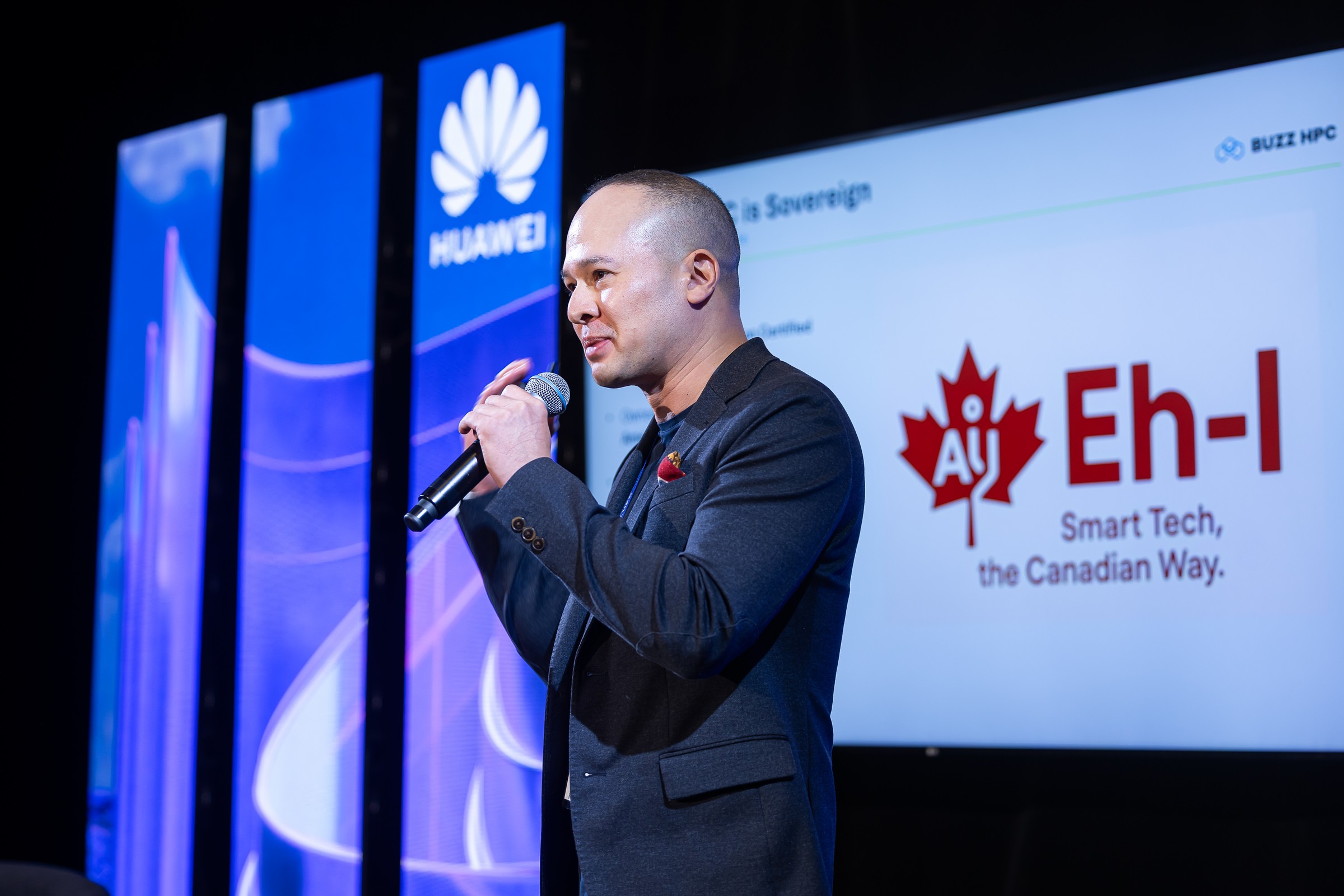
BUZZ HPC is one of the first providers building a sovereign AI cloud in Canada with all infrastructure located on Canadian or allied soil.
In partnership with national players like Bell, BUZZ HPC is expanding Canada’s advanced AI infrastructure so organizations can get secure, on-demand access to large-scale GPU clusters located entirely in Canadian-owned facilities.
This means data stays under Canadian jurisdiction and meets strict residency and privacy requirements. As President and COO Craig Tavares emphasizes, "sovereign is the new standard for cloud computing, and this initiative marks the beginning of a new era for AI innovation in Canada."
BUZZ HPC’s cloud is designed to combine the raw power of HPC with the flexibility and ease of use of cloud. Users can launch H200 or HGX B200 Blackwell platforms interconnected with NVIDIA Quantum InfiniBand and NVLink. Clusters can be reserved for long projects or used on-demand for quick experiments. Users can choose raw bare metal, a Slurm scheduler, or fully managed Kubernetes workflows.
BUZZ HPC also provides white-glove advisory services for AI projects covering custom model development, scalable training, retrieval-augmented generation, and agentic AI solutions. Their platform supports the full AI lifecycle with enterprise-grade security, Tier III+ data centers, ISO 27001 and SOC 2 certifications, and full-stack encryption.
FirstPrinciples, a Canadian non-profit research organization, recently partnered with BUZZ HPC to build an “AI Physicist” to accelerate scientific discovery.
By leveraging BUZZ HPC’s sovereign cloud, they can access world-class GPU clusters on demand without heavy IT overhead.
Enterprise and academic users also benefit. Columbia University faculty reported guaranteed access to required compute, and another client reduced AI inference costs by seven times.
BUZZ HPC optimizes workloads with vLLM, PagedAttention, and DF11 memory compression to maximize GPU utilization and reduce costs.
NeurIPS 2025 provided a glimpse of the future: AI agents that learn and imagine worlds, generative models that handle multiple modalities, and AI breakthroughs requiring massive compute.
High-end GPUs such as the H200 and B200 are essential, but making them accessible through platforms like BUZZ HPC is what levels the playing field.
🔗 Experience the power of sovereign, enterprise-grade AI compute for yourself at buzzhpc.ai.

