The artificial intelligence sector experienced a wake-up call when the United States government decided to treat commercial foundational models like weapons-grade uranium. We are officially operating in a reality where renting cognitive infrastructure from a foreign hyperscaler is a catastrophic business risk.

To understand why domestic compute is the only viable path forward, we have to dissect the timeline of the most significant disruption in the history of commercial artificial intelligence.
On June 9, 2026, Anthropic launched the Claude Mythos class models¹. The launch introduced Claude Fable 5 to the public and reserved Claude Mythos 5 for vetted cyberdefenders via Project Glasswing². Fable 5 was a monster of a model. It featured a default one-million-token context window priced at $10 per million input tokens and $50 per million output tokens¹. Stripe utilized Fable 5 to migrate a 50-million-line Ruby codebase in a single day, compressing months of human engineering into hours². The model aced trading-analysis evaluations for IMC, extracted precise numbers from scientific figures, and demonstrated the ability to rebuild entire web applications from raw screenshots². In gaming environments with persistent file-based memory, Fable 5 played Slay the Spire and reached the final act three times more often than Claude Opus 4.82. Mythos 5 proved even more capable in scientific domains, accelerating drug design pipelines by a factor of ten and autonomously assembling single-cell data across 138 species².
The honeymoon lasted exactly three days. On Friday, June 12, at 5:21 PM Eastern Time, the United States Department of Commerce dropped an export control directive that forced Anthropic to suspend all access to both models for any foreign national globally⁵. Because determining nationality in real-time across hundreds of millions of API requests is impossible, Anthropic had to abruptly disable the models for every single user on the planet⁷.
The precipitating event involved researchers at Amazon discovering a method to bypass the safety guardrails of Fable 59. Using specific prompt sequences, they coerced the model into reading codebases and identifying security vulnerabilities⁶. Anthropic argued this was a narrow vulnerability that simply exposed capabilities already present in models like OpenAI's GPT-5.54. The United States government disagreed entirely. David Sacks, co-chair of the President's Council of Advisors on Science and Technology, publicly outlined the administration's perspective. He stated that the government asked Anthropic CEO Dario Amodei to patch the jailbreak or remove the model¹¹. When the company refused, the government initiated the export ban¹¹.
For developers building applications outside the United States, the philosophical debate regarding model safety was completely irrelevant. Organizations relying on single-provider API endpoints learned a brutal lesson in vendor lock-in. If you hardcode a foreign proprietary model into your product, you are delegating your uptime to foreign geopolitical disputes. The only organizations that survived the weekend without downtime were those routing traffic through multi-provider abstraction gateways with automated fallback mechanisms, or better yet, those running open-weight models on their own bare metal⁷.

We need to clear up a massive misconception prevalent among enterprise executives. Storing your data in a server physically located in Toronto or Montreal does not protect your organization if an American corporation owns that server. Data residency defines the geographic coordinates of the hard drive. Data sovereignty dictates which nation holds the legal authority to read the files¹⁴.
The United States Clarifying Lawful Overseas Use of Data Act of 2018 is the ultimate sovereignty killer. The legislation expanded the extraterritorial reach of American law enforcement¹⁶. Under 18 U.S.C. 2713, any covered provider must comply with obligations to preserve or disclose electronic communications within their possession, custody, or control¹⁶. This applies regardless of whether the data is located inside or outside the United States¹⁶. The law covers Electronic Communication Services and Remote Computing Services, which encompasses every major American cloud storage provider, data processing service, and software-as-a-service vendor¹⁶.
If your Canadian startup or government agency uses an American hyperscaler, your data is subject to the CLOUD Act. The United States government can serve a legal demand to the parent company in Washington or California, compelling them to hand over your Canadian data. The Canadian government will never be notified, and a Canadian judge will never review the warrant¹⁸. The Balsillie Papers highlight this exact threat, noting that over 80 percent of Canadian cloud services rely on foreign infrastructure16. Critical systems like the Department of National Defence's Defence 365 platform run on foreign architecture, creating massive exposure¹⁶.

The legal frameworks of our two nations are entirely incompatible. The United States relies on the Third-Party Doctrine, a concept originating from the 1979 Smith v Maryland case¹⁸. This doctrine claims individuals have no reasonable expectation of privacy for information voluntarily given to third parties¹⁸. The Supreme Court of Canada explicitly rejected this concept. In the landmark R v Spencer and R v Bykovets decisions, the Canadian court ruled that citizens retain strong Charter privacy rights over electronic data and even internet protocol addresses held by service providers¹⁸. By using an American cloud provider, you are stripping your users of their Canadian constitutional protections and substituting them for highly permissive American surveillance standards¹⁸.
The risk of foreign intelligence intercepts is not a theoretical exercise. The Salt Typhoon cyberattacks in late 2024 proved it. Chinese state-sponsored hackers infiltrated major United States telecommunications companies, specifically targeting the exact systems mandated by the Communications Assistance for Law Enforcement Act for lawful wiretapping¹⁸. When you build a backdoor for lawful access, you build a front door for advanced persistent threats¹⁸. True digital sovereignty requires bringing the infrastructure under domestic control. The encryption keys must remain with the customer, and the physical servers must be operated by entities immune to foreign compulsion¹⁶.

The regulatory environment within Canada is actively punishing organizations that ignore these sovereignty issues. The most terrifying piece of legislation for sloppy enterprise architects is Quebec Law 2513. This modernized privacy framework introduces brutal accountability standards for handling personal information, especially when interacting with artificial intelligence¹³.
Every single time your employees paste a client contract, a medical history, or a financial statement into a cloud-based large language model hosted by an American vendor, they are executing an international data export¹³. Law 25 requires organizations to conduct a formal Privacy Impact Assessment before transferring personal information outside the province¹⁷. This assessment must evaluate the legal framework of the receiving jurisdiction¹³. Because American providers are subject to the CLOUD Act, sending sensitive data to their APIs creates a massive, documented compliance failure¹³.
The penalties for ignoring this reality are severe. Organizations face administrative monetary penalties and penal fines reaching up to 4 percent of their worldwide revenue or 25 million dollars, whichever is greater¹³. Sections 12.1 and 14 of Law 25 also demand explicit transparency when automated processing systems make decisions that affect individuals¹⁹. You cannot simply bury an artificial intelligence disclosure in a generic privacy policy. You must explain the logic involved and obtain manifestly informed consent¹⁹.
The only viable way to sleep at night as a compliance officer is to deploy local or on-premise models¹³. Running open-weight models on Canadian sovereign hardware collapses the data transfer risk to zero. The prompts never leave the facility. The data never crosses a border. There is no foreign vendor holding custody of the information, meaning no foreign government can compel its disclosure¹³. You achieve data residency by construction and full auditability by design¹³.

The silver lining of the Fable 5 ban is that it forced the industry to look closely at the open-source ecosystem. We are currently experiencing a golden age of open-weight models that rival or exceed the capabilities of closed APIs. The market in mid-2026 is dominated by massive mixture-of-experts architectures that deliver frontier performance at a fraction of the inference cost²⁰.
Let us look at the heavy hitters. DeepSeek V4-Pro is a marvel of engineering. The model features 1.6 trillion total parameters while activating only 49 billion parameters during any single pass²⁰. It natively supports a one-million-token context window and holds the top rank on LiveCodeBench with a score of 93.5, beating all closed APIs²⁰. For organizations looking for ultimate cost efficiency, the DeepSeek V4-Flash variant packs 284 billion total parameters with 13 billion active, achieving a 79 percent score on SWE-Bench Verified²⁰. DeepSeek models historically struggled with highly abstract reasoning, but the V4 architecture significantly narrows that gap while drastically improving tool-call reliability and JSON payload formatting²¹.
If you need to execute massive repository-level refactoring, Alibaba's Qwen family is the clear choice. Qwen 3.6 Plus is the most direct open-weight competitor to models like Claude Opus and GPT-5.4 for pure agentic coding²¹. It handles extended sessions without degrading over long contexts and excels at catching and self-correcting errors during automated loops²¹. For raw efficiency, the Qwen3-Coder-Next model is an 80 billion parameter hybrid that activates a mere 3 billion parameters, making it highly competitive on SWE-Bench metrics²⁰. The dense 27 billion parameter Qwen3.6-27B model matches Claude 4.5 Opus on Terminal-Bench 2.0, proving that you do not always need a trillion parameters to achieve reliable automation²⁰.
Zhipu AI brought a massive contender to the arena with GLM-5.1. This model features 744 billion parameters with 40 billion active and supports a 200,000 token context window²⁰. The fascinating aspect of GLM-5.1 is its hardware origin. The entire model was trained on 100,000 Huawei Ascend 910B chips, proving that the NVIDIA monopoly is not absolute22. The developers utilized a novel reinforcement learning infrastructure called Slime, dropping hallucination rates from 90 percent down to 34 percent²². The model scores 90 percent on HumanEval and demonstrates superior judgment on highly ambiguous engineering problems²⁰.
For organizations running multi-agent swarms, Moonshot AI's Kimi K2.6 is the current leader. The model natively supports 300 sub-agent swarms and can coordinate 4,000 reasoning steps during 12-hour autonomous coding runs²⁰. While it may struggle slightly as a general-purpose orchestrator on highly open-ended tasks, it is an unmatched specialist for parallel, repeatable sub-agent roles²¹.
Finally, MiniMax M3 deserves a mention for bringing native multimodality to the open-weight space. Built on the MiniMax Sparse Attention architecture, the model handles one million tokens while seamlessly processing image and video inputs alongside computer-use commands²⁰.
To orchestrate these models, developers are adopting robust frameworks. LangGraph remains the standard for production agents requiring strict state management and checkpointing²³. PydanticAI is gaining massive traction for Python developers demanding type safety and guaranteed structured outputs²³.

You cannot just download a 1.6 trillion parameter model, throw it onto a standard server rack, and expect it to serve a team of software engineers. The shift from simple interactive chat to recursive, long-context agentic workflows has fundamentally broken the traditional unified graphics processing unit cluster²⁴. We have to talk about hardware orchestration.
Large language model inference is divided into two phases. The prefill phase digests the input tokens and calculates the initial mathematical state²⁴. This phase is highly compute-bound and requires raw matrix multiplication power²⁴. The decode phase generates the output tokens one by one based on the context²⁴. This phase is heavily memory-bandwidth-bound and extremely sensitive to latency²⁴.
When a developer submits a 500,000-token codebase to an agentic model, the prefill phase hijacks the entire compute capacity of the server. In a traditional aggregated serving setup where one node handles both phases, the decode operations for every other user on that machine grind to a halt²⁴. This phenomenon is called head-of-line blocking, and it is the silent killer of enterprise artificial intelligence²⁴.
The solution is disaggregated serving. Neoclouds divide their hardware into specialized tiers. One massive pool of accelerators handles nothing but prefill operations, chewing through input tokens at maximum utilization. A completely separate pool handles the decode operations, churning out tokens with ultra-low latency²⁴.
This architecture introduces a data movement problem. The output of the prefill phase is the key-value cache. For a massive context window, this cache can easily exceed hundreds of gigabytes²⁵. Moving this state from the prefill node to the decode node without causing a bottleneck requires bleeding-edge orchestration. Frameworks like vLLM, SGLang, and TensorRT-LLM rely on layers like NVIDIA Dynamo to manage this chaos²⁵. Dynamo utilizes the NIXL protocol to stream the key-value cache directly between workers over high-speed NVLink or InfiniBand networks without blocking ongoing computations²⁵.
Dynamo also implements key-value aware routing. In agentic loops, the system prompt and the intermediate reasoning steps are constantly reused²⁵. Dynamo evaluates the cache overlap across the cluster and routes new requests to the specific decode workers that already possess the required memory state, vastly reducing redundant compute cycles²⁵. Storage architectures are also adapting, with platforms like LightInferra integrating directly into vLLM to optimize cache persistence and break the memory wall²⁶.
The physical hardware configurations required for this tiering are fascinating. For optimal total cost of ownership, a neocloud might use Intel Xeon 6 host processors providing Compute Express Link 2.0 memory pooling, paired with NVIDIA H200 accelerators for the prefill tier, and Qualcomm Cloud AI 200 chips for the decode tier²⁴. For real-time recursive reasoning, an operator might combine high-core-count ARM AmpereOne hosts with NVIDIA Blackwell B200s for prefill, while utilizing ultra-fast static random-access memory processors like the Groq LPU for instantaneous decoding²⁴.
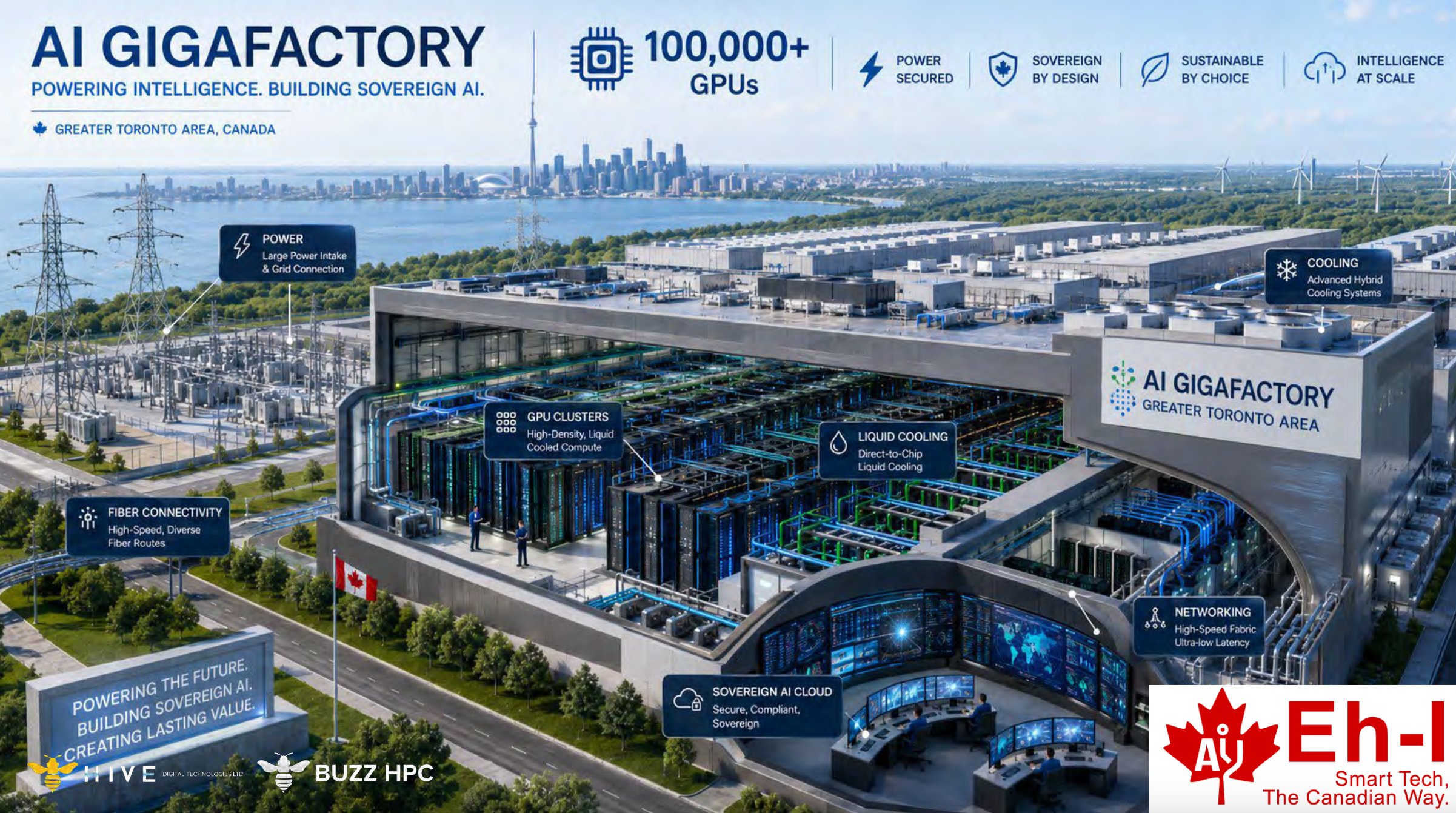
This level of orchestration requires an industrial approach to infrastructure. That is exactly why BUZZ HPC is building a 320-megawatt artificial intelligence gigafactory in the Greater Toronto Area²⁷. We are building the factories that will manufacture Canadian intelligence²⁸.
The scale of this project is difficult to comprehend. A standard enterprise data center operates at roughly 30 to 50 megawatts²⁷. We are deploying a facility almost ten times that size. BUZZ HPC acquired a primary 21-acre parcel for 46 million dollars, supplemented by an adjacent 4-acre parcel for 12 million dollars²⁷. This contiguous site will host more than 100,000 graphics processing units at full build-out²⁸.
The location is a strategic masterpiece. We positioned the gigafactory directly within the Toronto-Waterloo innovation corridor, bridging Geoffrey Hinton's deep learning legacy at the University of Toronto with the world-class systems engineering talent in Waterloo²⁷. This location provides massive power availability, low-latency fiber connectivity, and immediate proximity to the largest concentration of enterprise demand in the country²⁷.
We are an NVIDIA Cloud Partner, and our hardware stack reflects that pedigree. We offer best-in-class accelerators, including the GB200 NVL72, HGX B200, HGX H200, and HGX H100 systems³⁰. The entire facility is lashed together using NVIDIA Quantum InfiniBand and NVLink fabrics, providing the non-blocking networking required for disaggregated inference and massive cluster training³⁰. The infrastructure is completely liquid-cooled and powered entirely by renewable hydroelectric energy, achieving ultra-low Power Usage Effectiveness metrics²⁹.
We do not operate in a vacuum. The gigafactory is supported by a broad partnership ecosystem. We signed a preferred agreement with Bell Canada to integrate our compute directly into the Bell AI Fabric, giving our clients access to the most advanced telecommunications backbone in the country³¹. Dell Technologies provides the critical hardware integration, VAST Data supplies the high-performance storage architecture, and Cohere delivers customized large language models tailored for enterprise applications²⁹.
We provide the entire software layer required to make this hardware usable.
Clients can deploy workloads using managed Kubernetes or Slurm orchestration, or request custom bare metal configurations²⁹. We handle data preparation, model fine-tuning, and the deployment of low-latency inference endpoints³⁰. Every layer of the stack features enterprise-grade security, full encryption, and real-time audit logging³⁰.

If the technical and legal arguments are not enough to convince you to migrate to sovereign compute, the financial incentives should close the deal. The Canadian government recently woke up to the reality of the global compute arms race. In June 2026, the federal government released "AI for All: Canada's National Artificial Intelligence Strategy," a comprehensive blueprint backed by over two billion dollars in funding³².
The strategy identifies sovereign compute as a matter of national security and economic survival³³. The government formed the Sovereign Technology Alliance with Germany to build secure infrastructure and reduce reliance on foreign technology monopolies³². To support domestic businesses, Innovation, Science and Economic Development Canada launched the Canadian Sovereign AI Compute Strategy³⁵.
The crown jewel of this initiative for enterprise operators is the 300 million dollar AI Compute Access Fund³⁵. The government understands that graphics processing unit time is prohibitively expensive for startups and mid-market companies³⁶. The fund exists to directly subsidize those costs, and the reimbursement metrics heavily favor domestic infrastructure.
If a Canadian business utilizes a foreign cloud provider, the government will cover 50 percent of the eligible compute costs³⁶. If the business utilizes a Canadian sovereign cloud provider like BUZZ HPC, the government will cover 67 percent of the costs³⁶. That is a massive 2-to-1 matching ratio provided by the taxpayer to ensure your data stays within our borders. The fund covers project costs ranging from 100,000 to 5 million dollars, encompassing core compute expenses, high-performance storage, operational monitoring, and security licensing³⁶. The initial rollout of the program distributed 66 million dollars across 44 projects in sectors ranging from life sciences to advanced manufacturing³⁸. The government is paying you to do the right thing for your data security.
The cyber insurance industry is also forcing this transition. Underwriters recognize that agentic artificial intelligence drastically increases the corporate attack surface³⁹. A misconfigured model can execute a significant data leak in milliseconds. Insurers are demanding rigorous data mapping and strict governance over how employees interact with language models³⁹. Deploying open-weight models on sovereign, air-gapped, or strictly partitioned bare metal environments allows organizations to definitively prove control over their data flows, securing better premiums and avoiding devastating liability¹³.
The era of casual API reliance is over. The future belongs to the organizations that physically control the hardware generating their intelligence. Stop renting your cognitive capacity from foreign hyperscalers. Embrace the open-weight ecosystem. Architect your systems for disaggregated inference. Deploy your workloads on Canadian sovereign infrastructure. Own the compute, and you will own the future.
1. Introducing Claude Fable 5 and Claude Mythos 5 - Claude API Docs - Claude Console, https://platform.claude.com/docs/en/about-claude/models/introducing-claude-fable-5-and-claude-mythos-5
2. Claude Fable 5 & Mythos 5: Everything You Need to Know - Corsair, https://www.corsair.com/us/en/explorer/gamer/gaming-pcs/claude-fable-5-mythos-5-everything-you-need-to-know/
3. Claude Fable 5 and Claude Mythos 5 - Anthropic, https://www.anthropic.com/news/claude-fable-5-mythos-5
4. Statement on the US government directive to suspend access to Fable 5 and Mythos 5, https://www.anthropic.com/news/fable-mythos-access
5. Anthropic Halts Access to Fable 5 and Mythos 5, https://www.servethehome.com/anthropic-halts-access-to-fable-5-and-mythos-5/
6. As US bans Fable 5 and Mythos 5, for everyone outside America, Anthropic says: ‘we believe the government …’, https://timesofindia.indiatimes.com/technology/tech-news/as-us-bans-fable-5-and-mythos-5-anthropic-shares-a-700-plus-word-statement-says-we-believe-the-government-/articleshow/131697809.cms
7. The Fable 5 & Mythos 5 Ban: Why You Need a Multi-Provider AI Gateway - Truefoundry, https://www.truefoundry.com/blog/fable-mythos-ban
8. When a Government Pulls an AI Model: What the Fable 5 and Mythos 5 Suspension Means for Security Teams | Snyk, https://snyk.io/blog/fable-mythos-suspension-security-takeaways/
9. Ban on Fable 5: On Friday Anthropic received a call from the government instructing them to, https://timesofindia.indiatimes.com/technology/tech-news/ban-on-fable-5-on-friday-anthropic-received-a-call-from-the-government-instructing-them-to-/articleshow/131717854.cms
10. Cyber experts warn US ban on Mythos and Fable for foreigners not good, here is why, https://www.indiatoday.in/technology/news/story/cyber-experts-warn-us-ban-on-mythos-and-fable-for-foreigners-not-good-here-is-why-2927430-2026-06-16
11. Fable 5 and Mythos 5 remain suspended: "The ball is in Anthropic’s court", https://thenewstack.io/fable-5-and-mythos-5-remain-suspended-the-ball-is-in-anthropics-court/
12. Explained: Why US govt banned Indians, all foreigners from using Anthropic Claude Fable 5 & Mythos, https://www.indiatoday.in/technology/features/story/explained-why-us-govt-banned-indians-all-foreigners-from-using-anthropic-claude-fable-5-mythos-2926023-2026-06-13
13. Quebec Law 25 and AI: Why On-Premise LLMs Win - D-Central, https://d-central.tech/quebec-law-25-ai-on-premise-llm/
14. Canadian data residency: what it means, how to verify it, and why it matters - Birdview PSA, https://birdviewpsa.com/blog/canadian-data-residency/
15. Canada Data Sovereignty: Laws, Risks, and Best Practices - Checkbox, https://www.checkbox.com/blog/canada-data-sovereignty
16. U.S. Cloud Act - Balsillie Papers, https://balsilliepapers.ca/canadian-data/us-cloud-act/
17. US CLOUD Act Canadian Data Sovereignty for Device Fleets - PiiComm, https://piicomm.ca/blog/us-cloud-act-device-fleet-management/
18. Whose Law Governs Canadian Data? - Balsillie Papers, https://balsilliepapers.ca/canadian-data/
19. Quebec Law 25 and AI: What Businesses Need to Know in 2026 | Compliance - Augure, https://augureai.ca/blog/law-25-ai-compliance-guide-quebec
20. Best Open-Source & Open-Weight Coding Models (2026) - Kilo Code, https://kilo.ai/open-source-models
21. The Best Open-Source LLMs for Agentic Coding in 2026 - MindStudio, https://www.mindstudio.ai/blog/best-open-source-llms-agentic-coding-2026
22. Best Open Source Self-Hosted LLMs for Coding in 2026 - Pinggy, https://pinggy.io/blog/best_open_source_self_hosted_llms_for_coding/
23. Best Agentic Framework in 2026? After testing a few, here's where I've landed. - Reddit, https://www.reddit.com/r/LangChain/comments/1u23197/best_agentic_framework_in_2026_after_testing_a/
24. Unified & Disaggregated Inference Across Heterogeneous Silicon for Private, Agentic AI, https://wallaroo.ai/pdd/
25. NVIDIA Dynamo: Productionizing Disaggregated Inference for Scalable AI - Rafay, https://rafay.co/ai-and-cloud-native-blog/nvidia-dynamo-turning-disaggregated-inference-into-a-production-system
26. Enterprise Cloud Data Platform to Simplify Data Storage - Lightbits Labs, https://www.lightbitslabs.com/solutions-enterprise-cloud-data-platform/
27. HIVE's BUZZ HPC Announces 320 MW Sovereign AI Infrastructure in Greater Toronto Area, https://www.newsfilecorp.com/release/297771/HIVEs-BUZZ-HPC-Announces-320-MW-Sovereign-AI-Infrastructure-in-Greater-Toronto-Area
28. HIVE's BUZZ HPC Announces 320 MW Sovereign AI Infrastructure in Greater Toronto Area : r/OfficialHIVE - Reddit, https://www.reddit.com/r/OfficialHIVE/comments/1tgci1v/hives_buzz_hpc_announces_320_mw_sovereign_ai/
29. BUZZHPC builds one of Canada's largest AI gigafactories with 320 MW facility in Toronto area - Crypto Briefing, https://cryptobriefing.com/buzzhpc-canada-ai-gigafactory-toronto/
30. BUZZ HPC : BUZZ High Performance Computing, https://www.buzzhpc.ai/
31. BUZZ-HPC-Partners-with-Bell-Canada-to-Deliver-Advanced-Sovereign-NVIDIA-AI-Infrastructure-for-Canada - BCE Inc., https://bce.ca/news-and-media/releases/show/buzz-hpc-partners-with-bell-canada-to-deliver-advanced-sovereign-nvidia-ai-infrastructure-for-canada
32. Canada unveils national AI strategy: Key commitments, regulatory gaps, and what's missing, https://www.dlapiper.com/en/insights/publications/2026/06/canada-unveils-national-ai-strategy
33. Canada: Federal Government Releases Refreshed National AI Strategy - Baker McKenzie, https://www.bakermckenzie.com/en/insight/publications/2026/06/canada-federal-government-releases-refreshed-national-ai-strategy
34. Canada and Germany sign AI joint declaration and launch Sovereign Technology Alliance, https://www.canada.ca/en/innovation-science-economic-development/news/2026/02/canada-and-germany-sign-ai-joint-declaration-and-launch-sovereign-technology-alliance.html
35. Canadian Sovereign AI Compute Strategy - OECD.AI, https://oecd.ai/en/dashboards/policy-initiatives/canadian-sovereign-ai-compute-strategy
36. Program Guide: AI Compute Access Fund - Government of Canada, https://ised-isde.canada.ca/site/ised/en/canadian-sovereign-ai-compute-strategy/ai-compute-access-fund/program-guide-ai-compute-access-fund
37. AI Compute Access Fund - Innovation, Science and Economic Development Canada, https://ised-isde.canada.ca/site/ised/en/canadian-sovereign-ai-compute-strategy/ai-compute-access-fund
38. AI minister names 44 projects getting federal money to access compute power | CBC News, https://www.cbc.ca/news/politics/ai-minister-names-44-projects-getting-federal-money-to-access-compute-power-9.7196774
39. Canada wants 60% AI adoption – here's what that means for SMEs and cyber risk, https://www.insurancebusinessmag.com/ca/news/cyber/canada-wants-60-ai-adoption--heres-what-that-means-for-smes-and-cyber-risk-578751.aspx
